 |
« home
| search | shop |
submit
a tip | about
»
|
|---|
|
Related
Articles :- |
|---|
| Chocolate |
| Coffee |

Chili Peppers: History, Facts, and some Tips…
The chili pepper, the food that bites, came to Europe in the late 15th century. It was cultivated in Central America more than 5000 years ago. Pre-Columbian Americans used the chilli in their food for flavour also for its medicinal properties.; we now know it has a good range of vitamins and is very nutritious (the spelling of chili can be with one or two letter "l"s.)
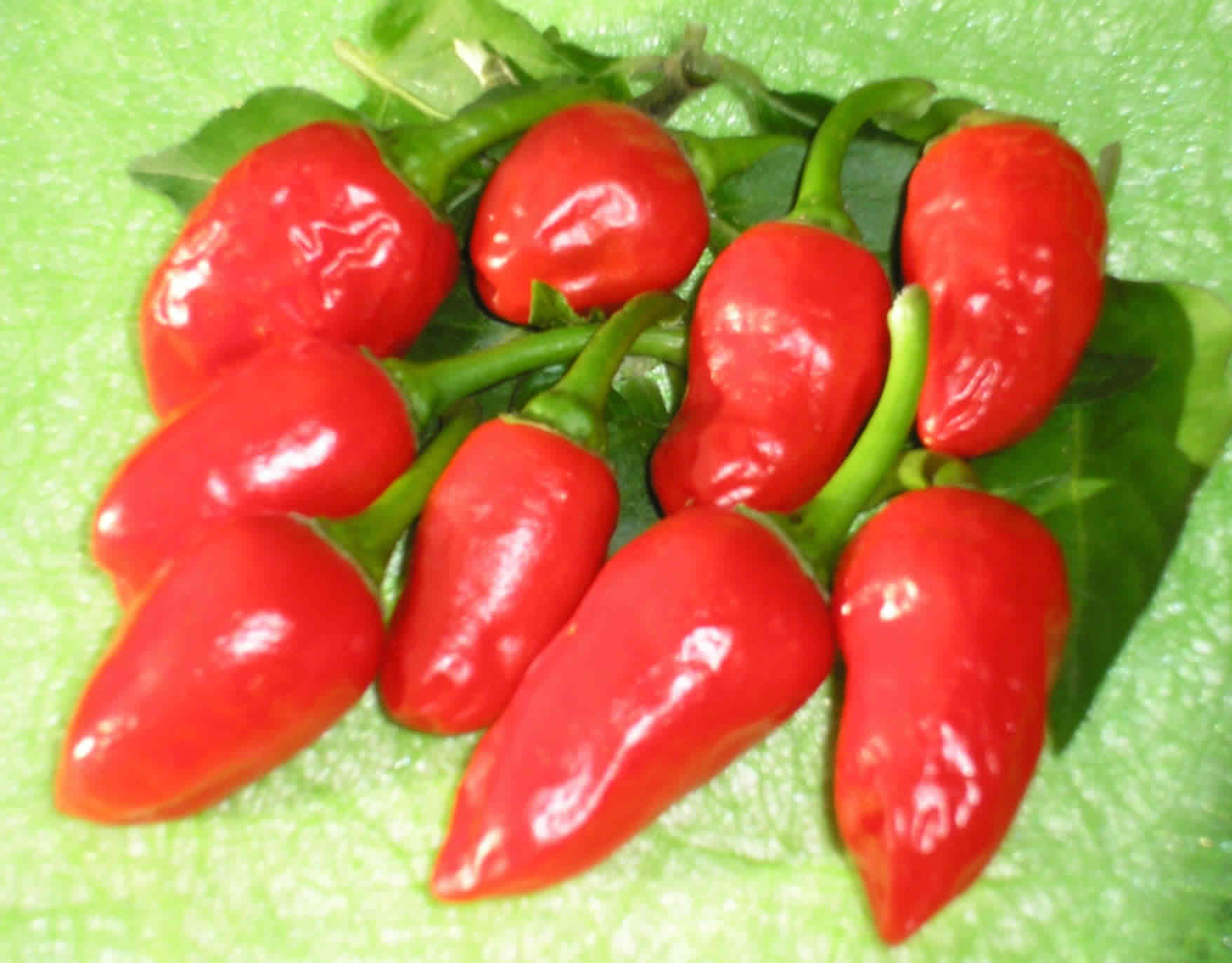
Chillies vary greatly in hotness, size shape, and can be found in a range of colours from yellow, through orange and red to green. Natural diversification, human intervention and biotechnology have produced dozens of varieties.
Recently the Central American varieties have been joined by new types coming back to the New World and Europe, from Asia, especially from India; including the 'Naga', perhaps the words hottest chillipepper. Despite a flood of new varieties The ever popular Jalapeño, holds its ground especially in a pickled form. When dried it becomes Chilpotle which is pungently aromatic. Like the unsmoked version it is available in a pickled form. Other currently popular versions are the Carribean Scotch Bonnet, Thai Penquin and Tabasco.
Further on in the article there is a listing of some of the very wide variety of the spice.
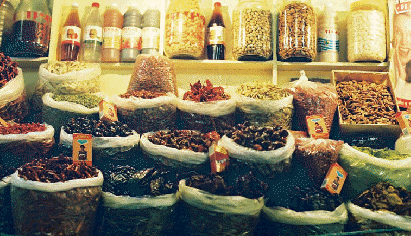
They can be eaten fresh, dried or pickled, they are of course easily purchased in the form of a sauce or paste, the article's author is particularly fond of a chilli sauce which also contains papaya. The variety of sauces displayed on the shelves of a delicatessen or even a supermarket is very wide indeed. Many restaurants, have a variety to choose from. A work colleague always has on his person a little bottle of tabasco, according to his wife he even takes it with him when on holiday.
What is the hottest chilli? According to the Guinness Book of Records it is the Bhut Jolokia at over a Million SHUs. See the News flashes below. These super hot chillies are Naga varieties originating from the North West of India. They seem to be Capsicum Chinense, which is also the species that produced the Habanero. The foothills of the Himalayas also produces a smallish pumpkin shaped, orange variety that is reported to be as hot or hotter than the Nagas. Some of the local peoples refer to it as the Sikkimese Cherry Chilli. A small green chilli from Assam; the Tezpur chilli held the record for a year or two.
Should we spell the word Chile or Chilli or should it have just one 'l' - Chili? It seems to be entirely up to you! Did you notice the different spellings in this article?
Tips for cooking
As a rule red fresh fruit are two or three times hotter than green fruit, and dried pods are up to ten times hotter than fresh pods.
The seeds and white pith of a chilli are the hottest part, so remove them if you don't want your dish to be too fiery.
Chillies contain a pungent oil that can cause an unpleasant burning sensation to eyes and skin. Try to avoid handling them too much, wear gloves if possible, and be sure not to touch your face or eyes during preparation.
As a general guide the smaller the chilli the hotter it will be.
Soaking a chilli in vinegar has the effect of distributing the hot chilli flavour through the dish. Discarding the vinegar and soaking again has the effect of further reducing the heat.
Warning: Gloves and eye protection and a mask are essential when chopping, peeling or processing the very hot varieties. No permanent damage normally results to a healthy person, but the shock to someone with a weak heart could be fatal!
Varieties
Some of the varieties of hot chillies:-
Aci Sivri, Aji Brown, Aji, Almapaprika, Anaheim, Ancho, Asain, Azr, Bahamian, BigJim, Birds Eye, Cabai Burong, Carolina Cayenne, Cascabel, Cayenne, Cheiro, Cherry, Chile de Arbol, Chiltecpin, Chiltepin Cherry, Chiltepin, Chimayo, Chipolte, Chipotle, Cobanero Mayan Love, Cobra, Coronado, Dagger pod, Demre, El Paso, Espanola, Guajillo, Habanero, Haimen, Hidalgo, Hot Wax, Hungarian Hot Wax, Hungarian, Jalapeno, Jaloro, Jamaican Hot, Japones, Jolokia, Kumataka, Lavingya, Manzano, Merah, Mexican Naga, Negro, Mirasol, Mulato, New Mexican, Naga, Nu Mex BigJim, Pasilla, Pepperoncini, Pequin, Piquin, Poblano, Pulla, Punjab, Pusa Jwalla, Putario, Puya, Red Savina Habanero, Rocoto, Rocotillo, Rocoto, Rojo, Sandia, Santa Fe Grande, Santaka, Santo Domingo Pueblo, Scotch Bonnet, Serrano, Serrano, Shipkas, Sikkimese Cherry Chili, Super Chile, Tabasco, Tabiche, Tepin, Tepîn, Tezpur, Thai, Trupti, Yatsafusa, Yellow, Yellow Wax, Zimbabwe BirdThe following can sometimes be mildly hot; Sweet Banana, Sweet Bells
How is hotness measured?The unit of hotness is the SHU or Scoville Hotness Scale. Wilbur Scoville was an eminent American chemist. He devised a test based on repetitively diluting an extract of the pepper with sugar water untilthe heat is no longer detected. Testing is now more usually performed using accurate laboratory equipment, namely a chromatograph, and equating 15 parts per million (PPM) of capsaicin with an increase of 1 on the Scoville scale.
Medicinal Value
As a Vermifuge; a US Army survival handbook suggests that eating raw chillies can expel worms from the gut.
Chili paste was used to wean babies; when it was decided that babies had to come off their mother's milk they would be deterred from suckling by the paste which was applied around the nipple.
Chilies have been recommended by some as having properties that can be used to treat long term and chronic pain, now scientists are developed a more targeted treatment using the capsaicin from chillies and the common pain killer lidocaine in combination. It is thought that the chilli extract opens up the receptors and allows in the anaesthetic. The big advantage over existing local anaesthetics is that if they are right they have found a local anaesthetic that does not have the usual side-effects of making the patient sluggish and slow-witted and allow more muscle control so that no longer would one have a 'frozen' face after a trip to the dentist.
The scientists who carried out the research, Binshtok AM, Bean BP and Woolf, are from Massachusetts General Hospital and Harvard Medical School.
Nutrition
Chillies are rich in C and the B Vitamins especially vitamin B6, They also contain Carotene which the body converts to Vitamin A.

News Flash#8!!
February 2012: Trinidad Scorpion Moruga Blend exceeds two million. In tests carried out at New Mexico State University it came out at 2,009,231 SHU. The university also showed that the another variety from the West Indies, the Trinidadian Chocolate 7-Pot Chili Pepper is hotter than the previous record holder at around 1.85 Million SHUs.News Flash#7!!
March 1st 2011: The Trinidad Scorpion "Butch T" variety takes the Guinness World Record with an astonishing 1,463,700 SHU. Butch Taylor, a chilli sauce producer bred the variety in Australia from seeds sent fromNews Flash#6!!
February 2011: Naga Viper takes the record at 1,382,118 scoville heat units.News Flash#5!!
November 2008: The Guinness Book of Records has replaced the entry naming the Red Savina variety of the Habanyera, tested at 577,000 SHU by the 'Bhut Jolokia' from Assam. This tested out at almost twice as hot - a million SHUs.!!!! (1,001,304)News Flash#4!!
October 2007: Tesco, the British owned supermarket giant has put some of the Dorset Naga (see below) on their shelves in northern English stores. Lets see if they can keep selling it without being sued?News Flash#3!!
November 2006: Dr David Julius working at the University of California in San Francisco has made a very interesting discoveries linking the active ingredient from chillies and a component of tarantula venom. One of the non-toxic substances found in the fluid injected during a tarantula bite is almost identical to capsaicin and works in exactly the same way.News Flash#2!!
April 2006: Dorset England;.Michael and Joy Michaud who run a company supplying chilli sauces and chillies by mail order. They purchased a Bangladeshi chilli from a local market and bred the new one from the seeds. Laboratory tests yielded results of 876,000 and 970,000 SHUs. April 2006News Flash#1!!
Tezpur, Assam is home to the hottest chilli in the world, the Naga Jolokia is smallish and green and rated at 800,000 plus on the Scoville scale. Now that is military or chemical warfare hot !!! June 2004
Related Spices: The hot spices work by fooling the body into experiencing pain. This is achieved by the active chemical fitting in to a type of mammalian pain receptor - the nociceptor.
Black Pepper: The hotness in pepper comes from the active ingredient Piperine, Chemical formula: C17H19NO3, Peppercorns are the seeds of the Asian vine Piper Nigrum, one of our most common spices. Threshold of taste is approximately 700ppm. Compare with Capsaicin the active ingredient in chillies - 10ppm.
Ginger: A rhizome from the ginger plant Zingiber Officinale. Zingerone, is the hot ingredient. It has several components to its taste and is reputed to have medicinal properties. The threshold of sensation with ginger is considerably more even than black pepper.
Why Hot??? It seems that for the chilli plant to propagate it is best if birds, rather than mammals carry the seeds, the pain receptors that respond to capsaicin are missing in birds, hence the birds do not experience the discomfort that we and other mammals do. Isn't nature smart. The scientific explanation is that capsaicin acts on a specific molecule on the surface of the pain sensing nerve fibres found in mammals causing a sensation of pain.
Why do we love the pain?? A credible explanation put forward is that the pain caused by the capsaicin causes endorphins to be generated in the body, these are the "pleasure chemicals". The pleasurable effects of the endorphins seem to last longer than the pain sensation, so we remember the last sensation and tend to forget the former. Any other explanations would be welcome.
Our page has been linked to by the BBC Website as an an informative and authoritative source of information on chillies. The BBC article is about the love affair between the Bhutanese people and the chilli:- http://news.bbc.co.uk/1/hi/world/south_asia/4315155.stm
Photography -- comi
« home | search | shop | submit a tip | about »